
HIGHLIGHTS
- AEO (Answer Engine Optimization) is emerging as a distinct discipline from traditional SEO, requiring separate optimization strategies.
- AI chatbots and generative engines rank content differently than Google, meaning your current SEO strategy may not guarantee visibility in answer engines.
- Brands must now optimize for multiple discovery platforms simultaneously to maintain comprehensive visibility across search, AI, and generative results.
The search landscape is fragmenting. For years, SEO has been the north star for visibility—optimize for Google, and your content reaches your audience. But that era is ending. Answer Engine Optimization (AEO) is now a separate discipline that demands attention, and brands that ignore it risk disappearing from one of the fastest-growing discovery channels: AI chatbots and generative engines.
What Answer Engine Optimization Actually Is
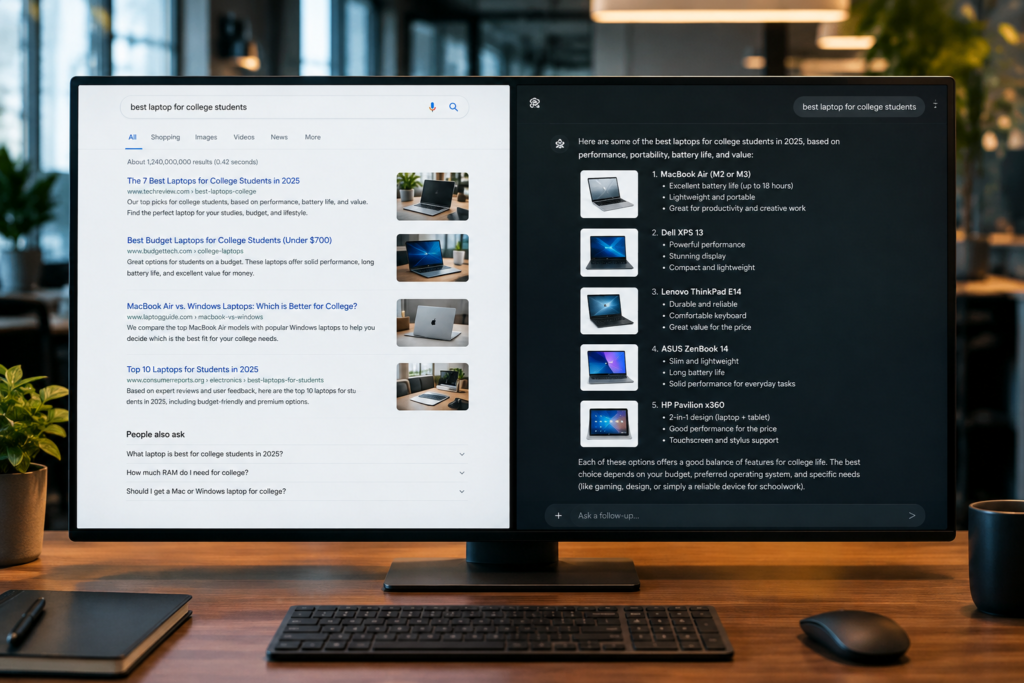
AEO refers to the practice of optimizing content to rank in answer engines—AI chatbots, generative search interfaces, and large language models like ChatGPT, Claude, and similar platforms. Unlike traditional search engines that return a list of results, answer engines synthesize information and serve direct answers to user queries. This fundamental difference changes everything about how content needs to be structured, written, and presented.
Answer engines don’t follow the same ranking signals as Google. They’re trained on different datasets, use different retrieval methods, and operate under different assumptions about what constitutes a “good” answer. A page that ranks first on Google for a given keyword may never appear as a source in an answer engine’s response—or it might appear buried beneath five other sources the engine considers more authoritative or relevant.
The shift from SEO to AEO isn’t about abandoning traditional search optimization. It’s about recognizing that visibility now requires optimization across multiple platforms simultaneously. Your audience is already using these tools; traffic from answer engines is growing, and content that doesn’t account for them is losing ground.
How Answer Engines Differ from Traditional Search
Search engines rank pages; answer engines synthesize content. When you search Google for “best running shoes for flat feet,” you get a list of sites ranked by relevance. When you ask ChatGPT the same question, it generates a cohesive answer that pulls information from multiple sources—or sometimes from none, if its training data is sufficient. This is a fundamental architectural difference with real consequences for content visibility.
Answer engines also prioritize clarity, comprehensiveness, and structure differently. They favor content that directly answers questions, provides clear explanations, and uses logical formatting. They reward depth and accuracy over keyword density. A blog post written for Google’s algorithm may be too thin for answer engines, or structured in ways that make extraction difficult. Conversely, content optimized for AEO—comprehensive, well-structured, and authoritative—often ranks better in traditional search as well.
The attribution model differs too. Google shows you exactly where each result came from; you can click through. Answer engines may mention sources in smaller text, or not surface them prominently. For brands, this means visibility can happen without traffic—your content is being read and synthesized, but users never click to your site. That’s both an opportunity and a challenge that requires new measurement and strategy.
Why Brands Must Adapt Now
The window to optimize for answer engines before they become dominant is closing. Adoption of AI chatbots for search and research tasks is accelerating. Users are becoming accustomed to asking questions and receiving synthesized answers. As these tools improve and market share grows, the brands that have already optimized their content for them will hold significant advantages in discoverability and authority.
Early movers in AEO have an edge. Content that’s currently being surfaced in answer engine responses is shaping how these platforms learn to interpret and present information. By optimizing now, brands aren’t just preparing for a future—they’re influencing the information architecture that answer engines are building. This is especially true for niche industries, where a small number of authoritative sources often dominate answer engine responses.
Waiting to optimize is a risk many brands can’t afford. If your competitors are already optimizing their content for answer engines while you focus solely on traditional SEO, they’re capturing visibility in a channel that’s still growing and less saturated. By the time answer engines become your primary traffic source, it may be too late to catch up.
Key Takeaways for Marketers
- Answer engines require separate optimization strategies—don’t assume your SEO approach will transfer directly to AEO.
- Structure content for clarity and comprehensiveness; answer engines reward direct answers over keyword-stuffed pages.
- Focus on authority and accuracy; these platforms prioritize trustworthiness and source credibility.
What this means for your business
If you’re selling products or services online, answer engines are already influencing purchasing decisions. A customer researching your product category may ask an AI chatbot for recommendations, and your content either appears in that synthesized answer or it doesn’t. To compete, audit your top-performing content—the pages that drive traffic and conversions today. Analyze whether they answer user questions comprehensively and directly, whether they’re structured in ways answer engines can easily parse, and whether they establish clear authority signals. Rewrite or restructure where necessary: use headers that directly answer questions, provide complete information without requiring users to click elsewhere, and cite credible sources to strengthen your own authority in the engine’s eyes.
Simultaneously, maintain your traditional SEO strategy. AEO and SEO, AEO & GEO aren’t mutually exclusive; they’re complementary. Content that works well in answer engines often performs better in traditional search too. Start with one or two high-value content pillars—the topics that drive the most revenue or traffic for your business—and optimize them for both search and answer engines. Test performance, measure visibility in answer engine responses, and iterate. As answer engines continue to grow, this dual-track approach will become non-negotiable, and having already built the expertise and process is something that positions your brand to lead.
