

HIGHLIGHTS
- B2B Google Ads CPCs are up roughly 21% on the same keywords — raising your budget without fixing conversion is the wrong first move.
- Creative quality and post-click experience are the highest-leverage places to recover margin when traffic costs rise.
- Track booked calls as hard conversion events, not clicks — only then can you see whether a CPC increase is actually hurting your real return.
A 21% CPC increase on the same B2B keywords is not just an inconvenience — it’s a forcing function that exposes every inefficiency already hiding in your Google Ads account. My honest take: most teams will respond by raising their monthly budget, and that is exactly the wrong first move.
What happened
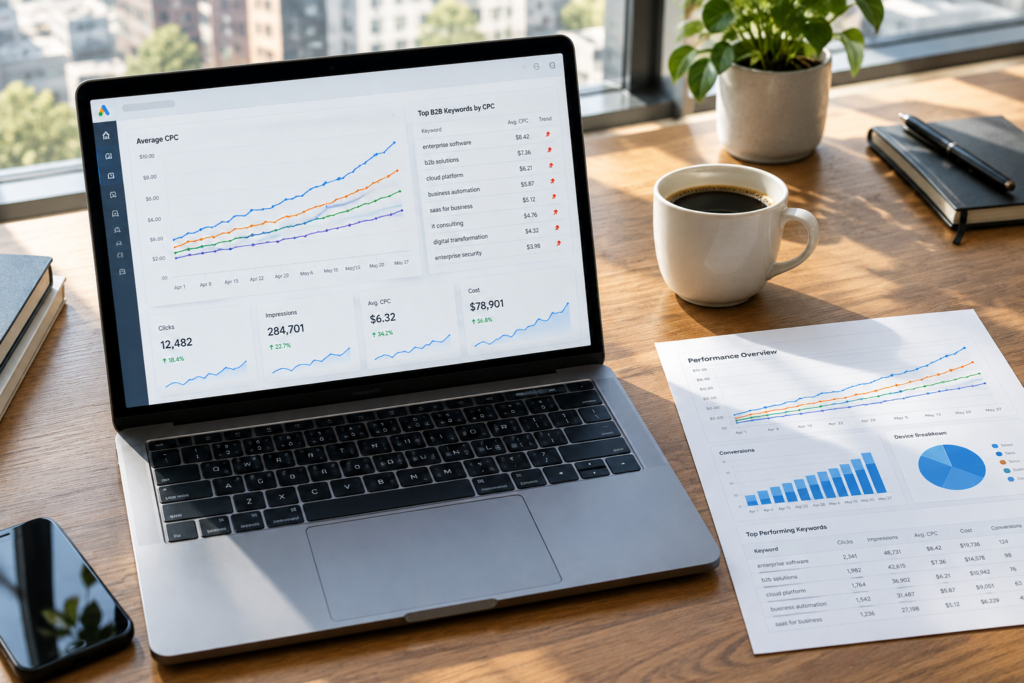
Agency data covering 14 B2B keyword categories showed that costs-per-click on Google Search have risen by roughly 21% year-over-year for the same terms. The increase is not tied to a single vertical — it appears broadly across B2B search, suggesting competitive pressure and Google’s own auction dynamics are both at play.
This comes as Google continues to push automated bidding strategies and broader match defaults, which tend to increase auction participation and, as a result, push CPCs upward across the board — including for advertisers who haven’t touched their settings.
Why this matters more than the headline number suggests
The 21% figure is jarring, but the real danger is subtler. When CPCs rise gradually, many accounts absorb the increase invisibly — the budget gets spent, the dashboard still shows clicks, and no one raises a flag until the cost-per-lead quietly doubles over a quarter. By then, the problem looks like a lead quality issue when it was always a unit economics issue.
What most people will get wrong here is treating this as a bidding problem. They’ll switch strategies, adjust target CPAs, or simply add budget. But if the landing page converts at 2% and a booked call happens on 15% of those leads, a 21% CPC increase means you’re paying proportionally more all the way down the funnel. No bid tweak fixes that math. The fix lives in two places: the creative that earns the click at a lower cost, and the page that converts the click into a real action.
We read results in three layers — content, ads, and what happens to the lead after the click. That third layer is where most B2B advertisers are flying blind. If you’re not tracking a booked call or a form submission as a hard conversion event in Google Ads, you are optimizing against a proxy metric while the actual business outcome drifts. A 21% CPC increase makes that blind spot expensive fast.
There’s also an asymmetry worth noting: your competitors are facing the same price increase. The ones who invest in better creative and tighter post-click experiences will see their effective cost-per-acquisition hold steady or even improve, while everyone else pays more for the same results. This is one of those moments where the gap between good and average accounts widens quickly.
What we would do this week
- Audit your conversion tracking first. If a booked call, a demo request, or a form fill is not firing as a primary conversion event in Google Ads, fix that before anything else — you can’t make smart decisions without it.
- Pull your cost-per-lead and cost-per-booked-call trends for the last 90 days. If CPL is rising in line with CPC, the problem is in the auction. If CPL is rising faster, the landing page is leaking.
- Test at least two new ad creatives — headlines and descriptions — specifically written to pre-qualify the click. A tighter message attracts fewer but more relevant clicks and can lower your effective CPC through improved Quality Score.
- Review your match types. Broad match with Smart Bidding expands your auction footprint and can quietly inflate CPCs on tangential queries. Check your Search Terms report for irrelevant traffic and tighten where needed.
- Run a landing page conversion rate check against industry benchmarks. If your page is below average for your category, a CRO test should take priority over any media budget decision.
Quick answers
Should I increase my Google Ads budget to maintain the same volume of leads?
Not automatically. First, check whether your current leads are converting into revenue at the rate you need. If the funnel below the click is working well, a targeted budget increase makes sense. If conversion rates are soft, adding budget just means paying more for the same underwhelming outcome.
Is this CPC increase permanent, or will it normalize?
There’s no reliable way to predict auction pricing, and waiting for CPCs to drop is not a strategy. The more useful frame is to build an account that remains profitable at higher CPCs — through better creative, tighter targeting, and a post-click experience worth the price of the click.
What this means for your business
If you run B2B Google Ads — even as a small business targeting local or niche professional buyers — this shift changes your margin math whether you noticed it yet or not. The brands that will come out ahead are the ones who stop treating paid search as a set-and-monitor channel and start treating it as an integrated system: the creative earns a qualified click, the landing page converts it, and every step is tracked back to a real business outcome like a call or a signed contract.
This is also a good moment to pressure-test whether your creative is doing real work. We’ve consistently found that creative is the biggest lever in paid media — more than audience adjustments or bid strategy changes. A stronger ad that earns trust before the click can hold your effective CPC down even as auction prices rise. Getting all of these pieces working together — tracking, creative, and landing page — is exactly the kind of system that a focused expert team can build and iterate quickly.